.png?sfvrsn=a4dc1c5f_6)
Interns present posters during their inaugural participation at APHL 2024
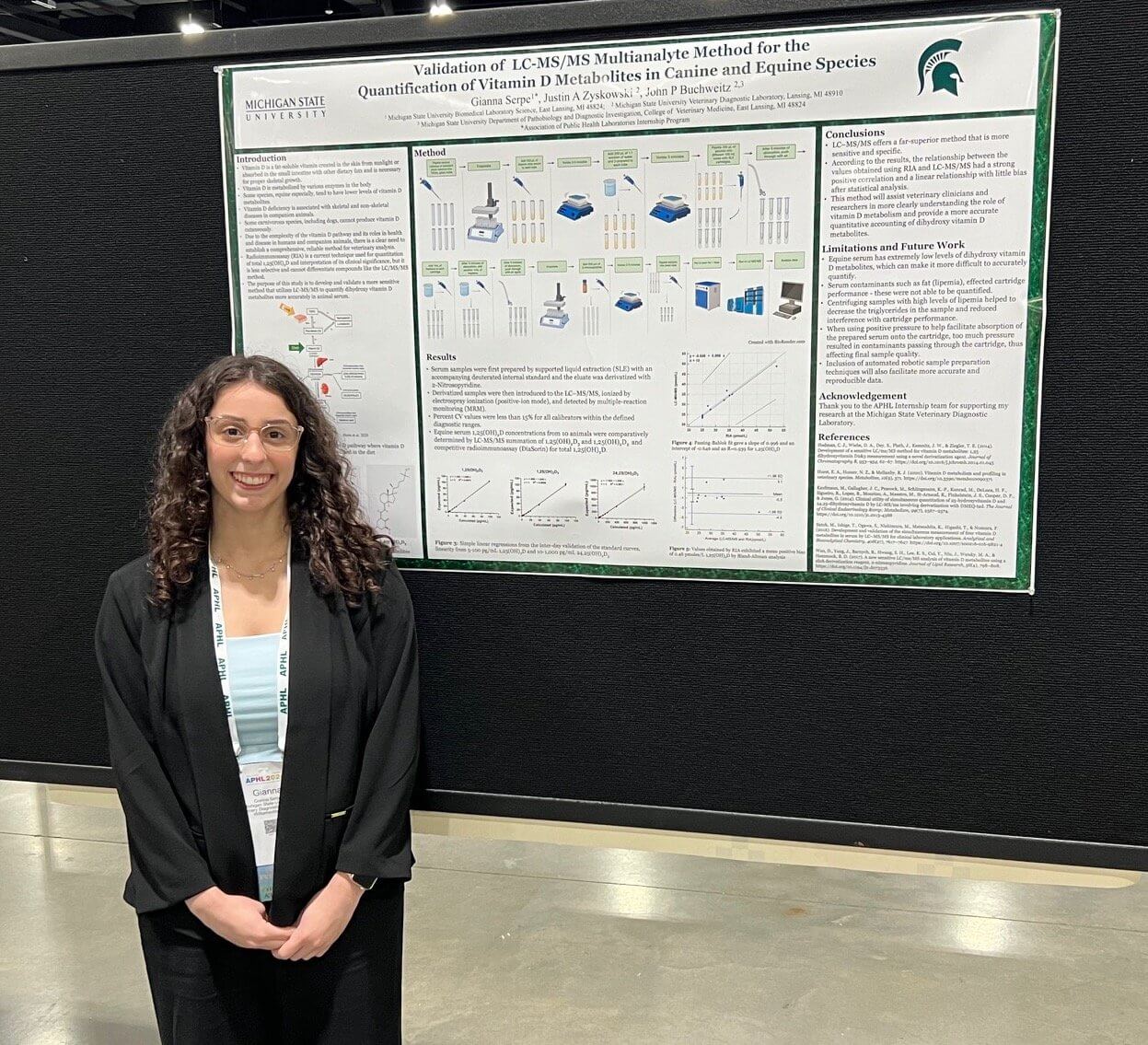
The 2024 APHL Annual Conference was the first time participants from the Public Health Laboratory Science Internship Program attended the annual conference. It was also the first time interns presented posters, too.
Six college students participating in the internship program were given the opportunity to attend the conference; two presented project posters.
Internship program participants, Gianna Serpe (pictured above), Delanie Prince and Allysea Smith, from Michigan State University, Tomi Ekibolaji, Lamar University, Darrel Gibson, Florida International University and Lucy Wellso, University of Wisconsin, were in attendance as the conference kicked off May 6.
Prince and Serpe, two interns from the Michigan State University Veterinary Diagnostic Laboratory, submitted posters relating to their projects at the lab.
Both will be entering their final semesters at Michigan State this fall and came to the internship programs through different paths.
Prince originally was going to study biomedical engineering, but MSU did not offer that program.
“The closest major they had was biomedical laboratory science. So that is what I stuck with and turns out, I love it,” Prince said.
One of Prince’s instructors sent her the link to the application for the internship program. When she got approved and matched for the internship, she found out the internship would be at the veterinary diagnostic laboratory.
“I was not sure how that would play with the human aspect of public health. But now after working there, I see the connections,” Prince said.
Prince was able to see how closely human and animal diseases are intertwined and how animals are often vectors for many human diseases. For Prince, the internship both expanded and complimented her interest in her field of study. She also saw the internship as an opportunity to attend a national conference.
For Serpe, her path to the internship program started with her desire to be a veterinarian. She had been working at the laboratory as a student worker before she found out about the internship program.
“I’m thinking of going to vet school and adding either a master’s in public health or a PhD in public health since a lot of schools offer a dual degree,” Serpe said.
But her internship also gave her a taste of working in the laboratory and seeing what happens with all the samples being taken from animals.
“I really like working in the laboratory. Once I started doing work at the vet diagnostic laboratory, I thought it was cool to see what happens after you get all the samples and see where they go and then what kind of tests are run,” Serpe said.
Their mentor, John Buchweitz, PhD, DABT, FADLM, FATS, was aware of the APHL Annual Conference and began thinking about the possibility of leveraging the students’ work into a professional experience.
“I saw the flyer for the Milwaukee conference, either in late December or early January, and I immediately put it on their desks and made them aware of it. We talked about what this could look like for them. At the time, I do not believe that there was funding available for interns, but I certainly wanted them to think about it,” Buchweitz, Nutrition & Toxicology Section chief at Michigan State University’s Veterinary Diagnostic Laboratory.
Buchweitz said his director has sponsored the attendance of many different types of students at conferences, but usually the only way they could attend would be if they were actively participating through the presentation of some scholarly work.
“So, it became a necessity to think about taking their projects and moving them into some sort of creative work or poster,” Buchweitz said.
Since his interns would be submitting project posters, Buchweitz wanted to know if there was any financial support available for his students.
The Internship Program began in March 2023 with no plans for the participation of interns during APHL’s annual conference. That all changed when Buchweitz reached out to Mariane Wolfe, manager of APHL’s Internship Program and asked, “Is this something that APHL would be willing to fund?”
Wolfe said she would consult with the US Centers for Disease Control and Prevention (CDC) about supporting intern participation at the annual conference and get back with him.
“Sure enough, about a week later, she said, ‘Yes, APHL would be willing to fund the trip,’” Buchweitz said.
With funding in place, Buchweitz, Prince and Serpe turned their attention to developing their projects into posters.
“My project started out as validating a new method for extracting fat-soluble vitamins, which are vitamins A and E, from animal tissue. When I arrived at my host laboratory, they already had a soft procedure in place,” Prince said.
Through trial and error, Prince helped the laboratory solidify the procedures.

“We figured out that you can’t extract vitamins A and E together, at least not right now,” Prince said.
Her poster became more about vitamin E because that was what conditions in the laboratory really favored.
Where Prince’s project ended up focusing on vitamin E, Serpe’s project looked at vitamin D.
“I would quantify vitamin D metabolites in animal serum. I would run them through a procedure and then we would throw them through liquid chromatography – mass spectrometry (LC-MS) and look at the results. We were validating the method because there’s also the method of radioimmunoassay, which has been used in the past or is still being used,” Serpe said.
She added that she was comparing methods to see if the LC-MS was more specific and sensitive. Serpe also made stock solutions and ran a lot of her own dilutions and then would see if she was getting consistent results with those too.
“When it came time to start making the conference posters, it was a little bit daunting because I had never done that for something that wasn’t like a chemistry lab or something for a class,” Delanie said. “But there was a lot of really great support within the host lab, especially by my mentor John (Buchweitz),” Prince said.
Buchweitz offered examples of different types of presentations that have been given at different conferences. The three of them identified the requirements for the APHL posters and then Prince and Serpe got to work.
“They (interns) come into the laboratory somewhat naively. They eventually work through techniques, gain confidence and are able to work through a problem seeing the pitfalls, the strengths and weaknesses, and then work toward an end goal,” said Buchweitz.
Ultimately, they each produced a poster and were prepared to talk confidently at the conference about the work that they produced.
“I could see it on both Delanie and Gianna’s faces. They were proud of the work that they had accomplished. Their interactions with other interns were positive, and you know they definitely walked away feeling like they had done something pretty unique. And they were proud of that,” Buchweitz said.